Proyecto PID2025-173671NB-I00 financiado por:

BRAINMOVE - Neural Sensorimotor Modelling for Adaptive Movement Control
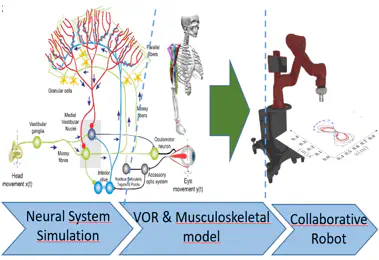 From neural circuit to robot — the BRAINMOVE pipeline: neural system simulation (cerebellum, basal ganglia and hippocampus), vestibulo-ocular-reflex and musculoskeletal models, and collaborative robot control.
Principal investigators: Eduardo Ros Vidal and Jesús Garrido Alcázar.
Biological motor control is far more efficient, adaptive and robust than the control strategies we can currently build into robots, and it does not rest on a single brain structure. BRAINMOVE investigates how key brain systems — the cerebellum, the basal ganglia and the hippocampus — jointly support efficient, adaptive and safe motor control, and how these principles can be translated into machine-learning controllers for collaborative robots with complex, compliant dynamics.
Biological motor control relies on distributed learning mechanisms: supervised sensory-prediction-error learning in the cerebellum, reinforcement learning and action selection in the basal ganglia, and sequential state representation and planning in the hippocampus. Their integration remains poorly understood. In parallel, the emergence of collaborative robots (cobots) with elastic actuation for passive safety compliance imposes new control challenges: elastic components improve safety, but at the cost of highly complex dynamics, which are difficult to model accurately and therefore challenging for traditional control methods. This has driven a growing interest in data-driven and machine-learning-based control, which promises to learn control laws or internal models directly from experience.
The project therefore studies:
- How the computational principles of the cerebellum and the locus coeruleus support supervised sensory-prediction-error learning and the neuromodulation of learning rates.
- How the basal ganglia implement reinforcement learning and action selection, and how the hippocampus sustains sequential state representation and planning.
- How these subsystems complement each other in the execution of movement, with a focus on the plasticity mechanisms that underpin them.
- How these computational and learning principles can be applied to efficient and accurate control of collaborative robotics with complex internal dynamics.
The central motivation of BRAINMOVE is to bridge these two worlds: on the one hand, to advance our understanding of the computational principles implemented by the cerebellum, the basal ganglia and the hippocampus in motor control; on the other, to translate these principles into bio-inspired learning architectures for the control of complex, compliant robots. A better understanding of plasticity dynamics, of how they are supported by the neurophysiological substrate, and of the construction of accurate models able to reproduce experimental results will also contribute to identifying dysfunctions associated with ageing or specific pathologies.
All of this is addressed within the framework of sensorimotor control tasks, validated both with simulated experimental set-ups — such as the vestibulo-ocular reflex (VOR) — and on collaborative robotic platforms.
Research team
Principal investigators: Eduardo Ros Vidal and Jesús Garrido Alcázar.
Research team: Mª Begoña del Pino Prieto, Eva Martínez Ortigosa and Ríchard R. Carrillo.
Work team: Diego Navarro Cabrera, Juan Helios García Guzmán, Jesús A. Cruz Vargas, Brayan A. Valencia Vidal, José B. Martínez Morales, Javier Ubago, María P. Tirado, Francisco Naveros, Ignacio Abadía and Álvaro González.
Funding
The project PID2025-173671NB-I00 is funded by MICIU/AEI/10.13039/501100011033 and by FEDER, UE.
The project runs from 1 September 2026 to 31 August 2029.

Eduardo Ros
Full Professor
Full professor in computer architecture, principal investigator at the Computational Neuroscience and Neurorobotics Lab and principal investigator of the VALERIA lab of the University of Granada.

Jesús Garrido
Associate Professor
Associate professor in Computation technology, senior researcher at the Computational Neuroscience and Neurorobotics Lab and principal investigator of the VALERIA lab of the University of Granada.

Ríchard R. Carrillo
Assistant Professor
Associate Professor at the Department of Computer Engineering, Automation and Robotics and Principal Investigator at the Applied Computational Neuroscience Group.

Diego Navarro
PhD Student
PhD student at the Applied Computational Neuroscience Research Group at the University of Granada.

Juan Helios García Guzmán
PhD Student
PhD student at the Applied Computational Neuroscience Research Group at the University of Granada.

Adán Cruz
PhD Student
PhD Candidate at the Applied Computational Neuroscience Research Group at the University of Granada.

Brayan Alfonso Valencia Vidal
Postdoctoral Researcher
Postdoctoral researcher in the Applied Computational Neuroscience Group, working on bio-inspired robotics and control.

José Bernardo Martínez
PhD Student
PhD Candidate at the Applied Computational Neuroscience Research Group at the University of Granada.

Javier Ubago
PhD Student
PhD student at the Applied Computational Neuroscience Research Group at the University of Granada.

María P. Tirado
PhD Student
PhD Candidate in Applied Computational Neuroscience at the University of Granada.

Francisco Naveros Arrabal
Associate Professor
Associate Professor in the Department of Architecture and Technology of Computer Systems at the Universidad Politécnica de Madrid.

Ignacio Abadia
Postdoctoral Researcher
Postdoctoral Researcher at the Applied Computational Neuroscience Research Group at the University of Granada.

Álvaro González
Postdoctoral Researcher
Postdoctoral researcher at the Applied Computational Neuroscience Research Group at the University of Granada.