Proyecto PID2022-140095NB-I00 financiado por:

SENSCOMP - Simulation of the neural computational substrate in the sensorimotor system. Adaptation mechanisms and their integration in experimental platforms
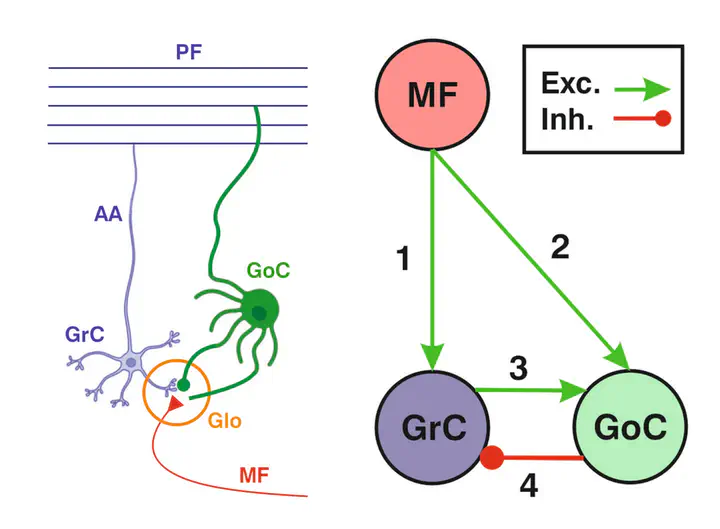 Cerebellar granular-layer microcircuitry —mossy fibres (MF), granule cells (GrC) and Golgi cells (GoC), with their excitatory and inhibitory connections—, the substrate whose adaptation mechanisms SENSCOMP models.
Principal investigators: Eduardo Ros Vidal and Jesús Garrido Alcázar.
Understanding the brain as a computational system — and how its different capabilities rest on specific properties of cells, the topology of neural networks and adaptation mechanisms — is the main goal of computational neuroscience. In this framework, the general objective of SENSCOMP is to investigate how the cerebellum and the basal ganglia achieve efficient and precise control through their internal adaptation mechanisms.
In particular, the project studies:
- How the properties of Golgi cells and their associated synaptic plasticity help produce an efficient representation of somatosensory patterns for their subsequent processing in later layers.
- How adaptation mechanisms such as reinforcement learning are supported by the neurophysiological substrate, and how they contribute — in the basal ganglia and the cerebellum — to efficient adaptation.
- How the basal ganglia complement the cerebellum in motor-control tasks.
All of this is addressed within the framework of sensorimotor control tasks. The adaptation capabilities are validated with simulated experimental set-ups — such as the vestibulo-ocular reflex (VOR) or pro-/anti-saccadic movements — as well as with information-transmission estimators that assess the efficient representation of patterns in the granular layer. These new features are also integrated into embodied simulation tools (neurorobotics), in order to explore how they can contribute to accurate control tasks with collaborative robots as validation platforms.
Research team
Principal investigators: Eduardo Ros Vidal and Jesús Garrido Alcázar.
Research team: Mª Begoña del Pino Prieto, Antonio Cañas Vargas, Eva M. Martínez Ortigosa and Ríchard R. Carrillo.
Work team: Álvaro González, Francisco Naveros, Ignacio Abadía, Javier Ubago and María P. Tirado.
Funding
Project PID2022-140095NB-I00 funded by MICIU/AEI/10.13039/501100011033 and by FEDER, UE.
The project ran from 1 September 2023 to 31 August 2026.

Eduardo Ros
Full Professor
Full professor in computer architecture, principal investigator at the Computational Neuroscience and Neurorobotics Lab and principal investigator of the VALERIA lab of the University of Granada.

Jesús Garrido
Associate Professor
Associate professor in Computation technology, senior researcher at the Computational Neuroscience and Neurorobotics Lab and principal investigator of the VALERIA lab of the University of Granada.

Ríchard R. Carrillo
Assistant Professor
Associate Professor at the Department of Computer Engineering, Automation and Robotics and Principal Investigator at the Applied Computational Neuroscience Group.

Álvaro González
Postdoctoral Researcher
Postdoctoral researcher at the Applied Computational Neuroscience Research Group at the University of Granada.

Francisco Naveros Arrabal
Associate Professor
Associate Professor in the Department of Architecture and Technology of Computer Systems at the Universidad Politécnica de Madrid.

Ignacio Abadia
Postdoctoral Researcher
Postdoctoral Researcher at the Applied Computational Neuroscience Research Group at the University of Granada.

Javier Ubago
PhD Student
PhD student at the Applied Computational Neuroscience Research Group at the University of Granada.

María P. Tirado
PhD Student
PhD Candidate in Applied Computational Neuroscience at the University of Granada.

